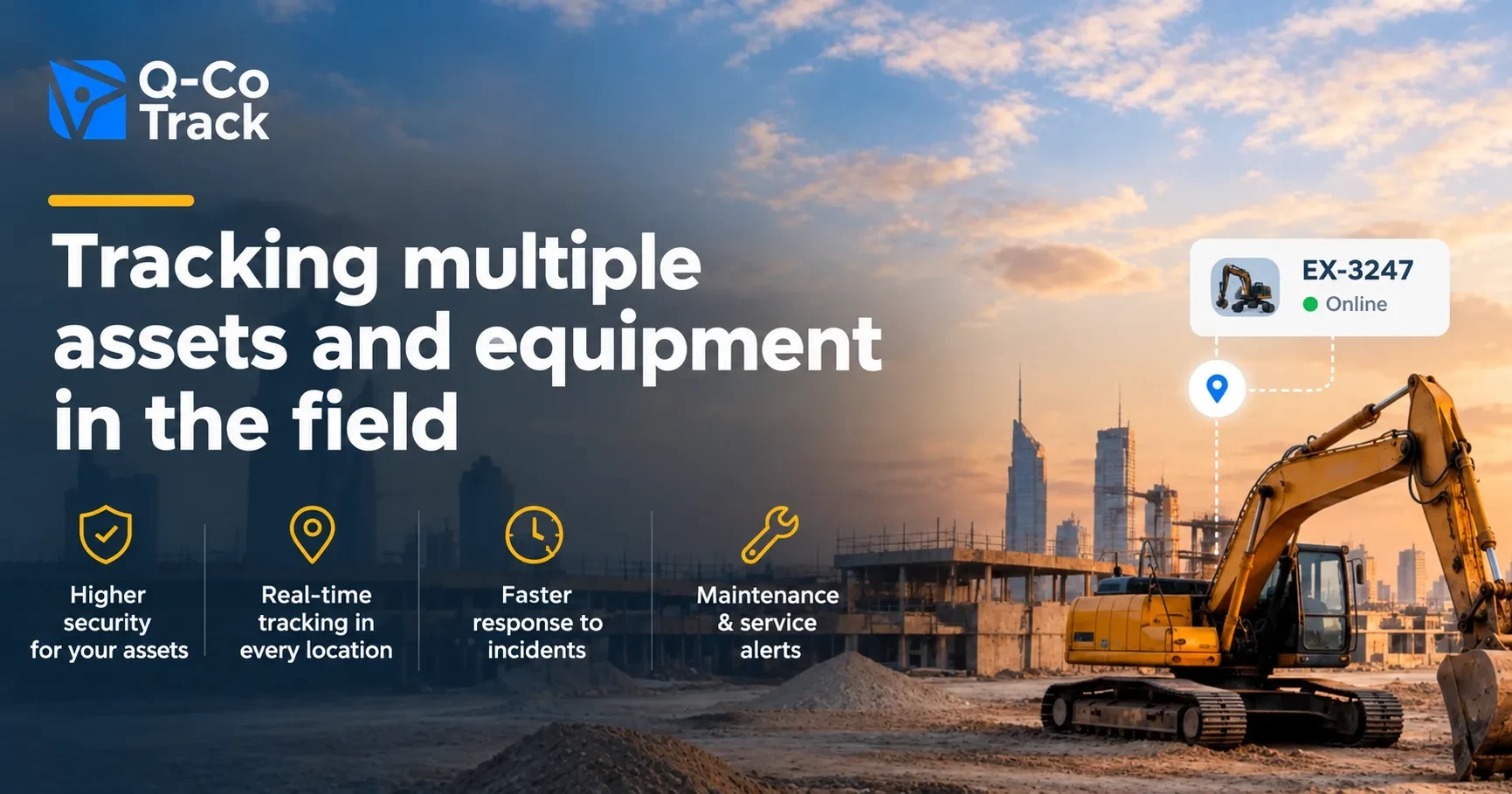
Tracking and securing construction equipment and heavy machinery in Kuwait
Construction companies in Kuwait rely on valuable machinery, including excavators, cranes and heavy-duty trucks. **Construction equipment tracking in Kuwait** helps businesses monitor equipment locations, track operating hours and identify unauthorized use across multiple job sites. With GPS tracking, fleet managers can set geographical boundaries, receive movement alerts and use available operating data to support preventive maintenance. QcoTrack provides GPS tracking solutions that help construction companies improve equipment visibility, strengthen asset management and enhance operational efficiency.
Challenges of Equipment Misuse and Theft on Construction Sites
Construction companies face a range of operational and administrative challenges, particularly when managing heavy machinery across several sites. Without reliable tracking data, it can be difficult to maintain clear records of equipment usage, movement and availability.
Common challenges include:
-
Equipment being operated outside approved working hours without management’s knowledge.
-
Machinery being transferred between sites without accurate movement records.
-
Difficulty locating equipment when a project requires it.
-
Equipment running for longer than necessary, potentially reducing operational efficiency.
-
Challenges monitoring heavy machinery distributed across multiple construction sites.
-
Equipment going missing and becoming difficult to recover.
These challenges can affect project coordination, asset security and equipment utilization.
With GPS tracking for construction equipment in Kuwait, managers can monitor equipment locations and movements and receive alerts when tracked assets leave predefined geographical boundaries or when configured conditions are triggered. Tracking systems can also provide movement histories and fleet management reports containing available information about vehicle locations, routes and recorded speeds.
By giving managers better visibility into equipment activity, QcoTrack’s GPS tracking system can help reduce reliance on manual follow-ups and support more informed operational decisions.
Accurately Monitoring Construction Equipment Engine Hours
For companies managing fleets of vehicles and heavy machinery, knowing an asset’s location is only part of effective equipment management. Understanding how long its engine operates can also help managers assess utilization, plan maintenance and identify unnecessary operating time.
Engine-hour monitoring provides useful operational information, including:
-
Measuring operating time: Determine how long a vehicle or machine has operated during a selected period, where the tracking system supports this measurement.
-
Comparing actual and planned usage: Review recorded operating activity against the company’s operational schedule.
-
Identifying unauthorized operation: Investigate operating activity outside approved working hours or when equipment is not expected to be in use.
-
Planning maintenance: Use available engine-hour readings to help schedule maintenance according to the manufacturer’s recommendations and the company’s maintenance plan.
When operating-hour data is used alongside location and movement records, tracking becomes more than a map showing where equipment is located. It becomes a source of operational information that helps managers understand equipment utilization and make better-informed decisions.
For construction companies looking to evaluate operational efficiency more broadly, fleet performance KPIs indicators can complement equipment tracking data.
Using GPS Geofencing to Manage Equipment Across Construction Sites
When a construction company operates across several projects, keeping track of equipment movement between locations can be difficult. GPS geofencing helps address this challenge by allowing managers to define virtual geographical boundaries around selected sites or areas.
For example, a company may establish geofences for construction projects in Al-Mutlaa or the Shuwaikh Industrial Area. Depending on the tracking platform’s features and configuration, managers can review recorded entries into and exits from these designated areas and receive alerts when specific geofence conditions are met.
Heavy equipment GPS tracking with geofencing can help companies:
-
Define geographical boundaries for construction sites and other operational locations.
-
Monitor recorded entries and exits at designated sites.
-
Receive alerts when tracked equipment crosses configured boundaries.
-
Maintain movement records for equipment transferred between projects.
-
Improve visibility into equipment allocation across multiple locations.
QcoTrack tracking devices support GPS tracking for compatible vehicles and equipment, while available geofencing and alert features depend on the device, platform and configuration.
These capabilities can help companies maintain clearer records of equipment movement instead of relying entirely on phone calls, manual logs and informal communication between sites.
For businesses managing fleets in other operationally demanding sectors, similar tracking principles are also relevant to the oil and gas industry.
Planning Preventive Maintenance with GPS Tracking Data
Equipment maintenance is an important part of managing construction assets. Unexpected breakdowns can disrupt project schedules, affect equipment availability and create additional maintenance costs.
GPS tracking data can give managers a clearer picture of equipment location and movement. When engine-hour readings or other supported operating data are available, these records can also help managers understand how equipment is being used and organize maintenance activities more effectively.
Combining tracking information with a preventive maintenance plan can help companies:
-
Review equipment usage and operating activity.
-
Organize maintenance schedules using available engine-hour data.
-
Identify equipment that may require inspection according to its maintenance plan.
-
Coordinate equipment availability across different construction sites.
-
Reduce dependence on incomplete manual records.
Maintenance should still be scheduled according to the manufacturer’s recommendations, inspection findings and the company’s maintenance procedures. GPS location data alone does not establish the mechanical condition of a machine.
Companies may also integrate tracking data with their internal software systems when a suitable technical integration is available. QcoTrack integration with various systems and software through APIs, subject to compatibility and implementation requirements.
This can help businesses incorporate available tracking information into their existing operational workflows rather than managing equipment records separately.
Manage and Secure Your Construction Equipment in Kuwait with QcoTrack
Managing heavy machinery across multiple construction sites requires reliable information about equipment locations, movements and operating activity. GPS tracking can help construction companies improve visibility, investigate unauthorized equipment use, establish geographical boundaries and use available operating-hour data to support maintenance planning.
If your company manages heavy equipment across different locations in Kuwait, QcoTrack can help you explore tracking solutions suited to your equipment types and operational requirements.
To see how tracking supports contractors beyond heavy machinery, read how contracting companies in Kuwait benefit from GPS car tracking devices . Contact the QcoTrack team to discuss your needs, learn about available tracking features and identify a suitable solution for your construction fleet.
Contact QcoTrack via WhatsApp to request a consultation and get answers to your questions.
Frequently Asked Questions
Can GPS trackers be installed on heavy construction equipment?
GPS tracking devices are available for various types of vehicles and equipment, including trucks, agricultural machinery and specialized equipment. Compatibility depends on the specific machine and the tracking device selected. You can also read about the installation and removal of vehicle GPS trackers in Kuwait before planning your installation.
Can I monitor construction equipment locations in real time?
GPS tracking systems can provide real-time or near-real-time location information, depending on device capabilities, connectivity and system configuration. Authorized users can access available location information through supported tracking platforms or mobile applications.
Can I set permitted areas for construction equipment?
Yes. Where geofencing is supported, users can define geographical boundaries and configure alerts for specified entry or exit events. This can help managers monitor equipment movement around designated construction sites and other operational locations.
Can GPS tracking help with construction equipment maintenance?
GPS tracking can provide useful location and movement information. Where engine-hour readings or other relevant operating data are supported, this information can also help managers plan maintenance activities. Maintenance schedules should follow the equipment manufacturer’s guidance and the company’s maintenance procedures.