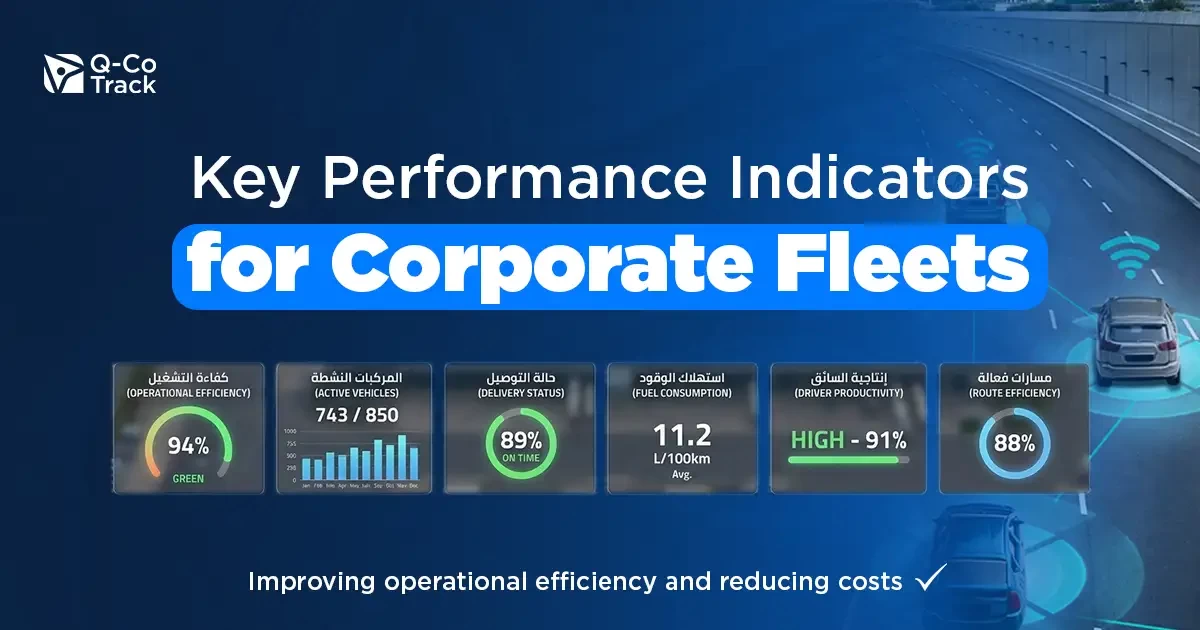
Fleet Management Key Performance Indicators
Companies that operate vehicle fleets are increasingly focusing on Fleet Performance Key Performance Indicators (KPIs) as a fundamental tool to evaluate operational efficiency, reduce costs, improve safety, and increase productivity. Without clear performance indicators, it becomes difficult for companies to identify weaknesses or make accurate decisions based on reliable data. In this article, we explain the most important KPIs for measuring company fleet performance and how businesses can use them to improve fleet management strategies.
What Are Fleet Performance KPIs?
Fleet Performance KPIs are numerical metrics used by companies to evaluate the performance of both drivers and vehicles in order to improve operational efficiency.
These indicators typically measure:
-
Fuel consumption
-
Maintenance and breakdown rates
-
Route compliance
-
Driver behavior during driving
-
Violations and accidents
-
Operating costs
The Purpose of Fleet Performance KPIs
The main goal of these indicators is to transform daily operational data into valuable insights that help companies:
-
Improve operational performance
-
Reduce operational risks
-
Increase overall fleet efficiency
Importance of Measuring Company Fleet Performance
Measuring fleet performance is a strategic element for companies that rely on transportation or field services. It helps businesses to:
-
Improve vehicle utilization
-
Reduce operating costs
-
Enhance safety levels
-
Support management decisions with accurate data
-
Improve on-time delivery performance
Companies that rely on Fleet KPI metrics achieve better fleet control, stronger operational performance, and higher profitability.
Key Fleet Management KPIs
There are several important operational KPIs that companies should monitor regularly.
Fuel Consumption Indicator
This KPI helps to:
-
Measure fuel usage for each vehicle
-
Identify fuel waste and inefficient driving behavior
Maintenance and Breakdown KPI
This indicator helps companies:
-
Track the number of breakdowns within a specific period
-
Measure maintenance costs per vehicle
Route and Schedule Compliance KPI
This metric evaluates:
-
Driver compliance with planned routes
-
Number of unauthorized stops
Driver Behavior KPI
This indicator measures driving behavior such as:
-
Over-speeding
-
Harsh braking
-
Aggressive acceleration
Vehicle Utilization Rate
One of the most important fleet performance indicators. It measures:
-
Total vehicle operating hours
-
Underutilized vehicles
Accidents and Violations KPI
This KPI tracks:
-
Number of accidents
-
Traffic violations per vehicle
-
Operational risk levels
Operating Cost per Vehicle
This KPI calculates total vehicle operating costs, including:
-
Fuel expenses
-
Maintenance costs
-
Insurance
-
Driver salaries
-
Emergency repairs
How Vehicle Tracking Systems Help Measure Fleet KPIs
Vehicle tracking systems play a critical role in measuring fleet performance KPIs accurately by providing:
-
Real-time vehicle tracking
-
Automatic performance reports
-
Driver behavior analysis
-
Instant alerts for violations
-
Route and trip history
-
Idle time and operating hours calculations
These features provide companies with:
-
Accurate data without manual input
-
Daily, weekly, and monthly performance reports
-
Easy comparison between vehicles for better decision-making
This is why GPS-based fleet management systems are essential for any successful KPI strategy.
How to Improve Your Fleet Performance KPIs
Improving fleet KPIs requires a clear strategy supported by professional vehicle tracking systems that provide:
-
Smart performance reports
-
Continuous monitoring
-
Accurate operational analytics
-
Driver safety training
-
Reduced accident rates
-
Lower fuel consumption
-
Fewer unexpected breakdowns
-
Longer vehicle lifespan
Regular report analysis helps identify weaknesses and improve driver commitment by linking performance to incentives and rewards.
Frequently Asked Questions
What are fleet performance KPIs?
Fleet KPIs are measurable indicators used to evaluate the operational efficiency of vehicles and drivers, including productivity, costs, and compliance with operational plans.
Why are KPIs important in fleet management?
Because they help reduce costs, improve operational performance, reduce accidents, and support management decisions with reliable data.
What is the relationship between vehicle tracking systems and fleet KPIs?
Tracking systems provide the necessary data—such as location, speed, fuel usage, and idle time—to calculate and analyze fleet performance KPIs.
Can fleet performance be improved without a tracking system?
It is very difficult, as decisions would rely on estimation rather than accurate data, which reduces management efficiency.
Start Managing Your Fleet with Data-Driven Decisions
Do not let fleet management depend on assumptions. A professional vehicle tracking system can help you measure Fleet Performance KPIs accurately and improve operational efficiency.
Contact QCO Track experts today to get a complete fleet tracking solution tailored to your company’s needs.
Turn your fleet data into powerful decisions that drive business growth — because effective fleet control starts with measuring performance.